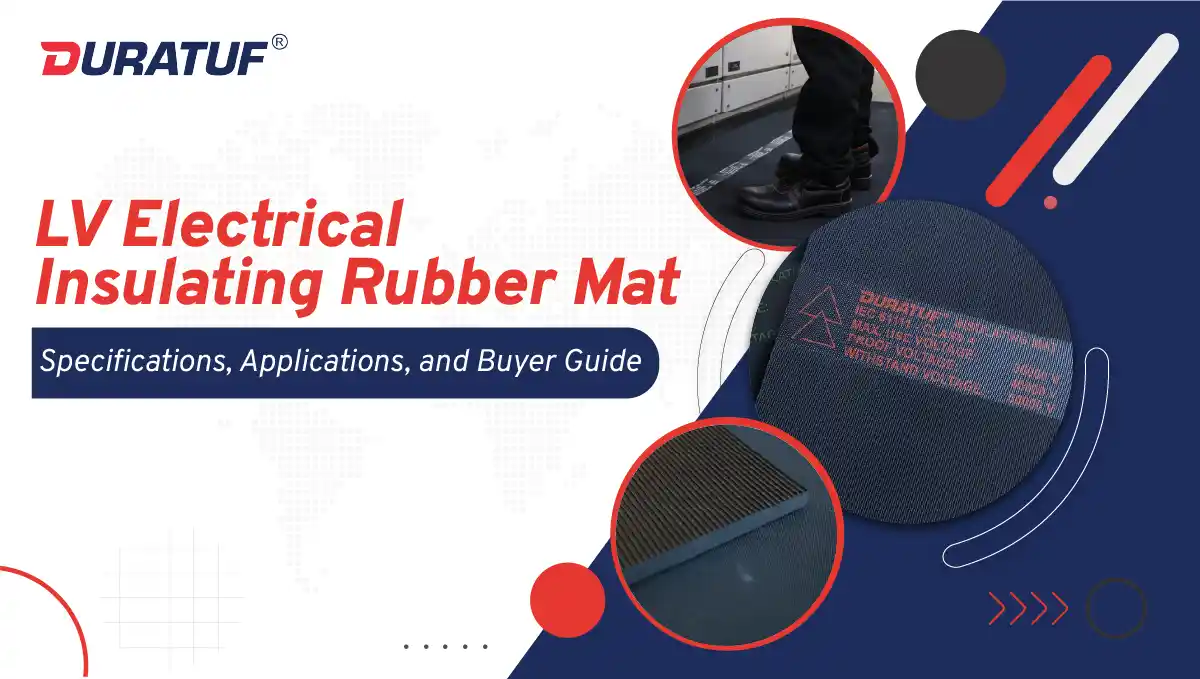
LV Electrical Insulating Mat: 1kV Mat Specifications, Applications, Installation & More
Every building, factory, warehouse, hospital, and data centre has low-voltage electrical panels. The 415V distribution board, the 480V MCC room, the 1kV generator output panel, these are found in more installations globally than any higher-voltage equipment combined. Yet the LV electrical insulating mat is the most frequently under-specified piece of electrical safety equipment in industrial procurement. The assumption that low voltage means low risk is both common and wrong. A 415V shock is fatal. The mat requirement exists precisely because of that.
Two international standards cover the 1kV electrical rubber mat for low-voltage electrical safety: IEC 61111:2009 Class 0 and ASTM D178 Class 0. For Indian industries operating under IS 15652, Class A (3.3kV working voltage) is the applicable standard, as IS 15652 has no lower class. This guide covers the correct technical specifications, applications, certifications, and procurement requirements for LV insulating mats used across industries Worldwide.
Which Class of Electrical Insulating Mat is Required for Low-Voltage Installations?
When specifying what class insulating rubber mat for LV installations is required, the answer is Class 0 under IEC 61111 and ASTM D178. Class 0 has a maximum use voltage of 1.0 kV, covering the full range of low-voltage electrical systems from 415V to 1000V AC.
IEC 61111:2009 (International): An IEC 61111 Class 0 mat is the correct specification. It has a maximum use voltage of 1.0 kV, an AC proof test voltage of 5.0 kV, and a withstand voltage of 10.0 kV. A Class 0 insulating mat to IEC 61111 is the most widely used electrical rubber mat globally. It is used across Europe, the Middle East, Asia-Pacific, UK, and export markets wherever 415V or 1kV LV systems require floor-level electrical insulation.
ASTM D178 (Americas): An ASTM D178 Class 0 mat is the correct specification for North and South American installations. It shares the same maximum use voltage (1.0 kV), AC proof test voltage (5.0 kV), and dielectric voltage (10.0 kV) as IEC 61111 Class 0. It is used at 480V distribution boards, 600V industrial panels, and 1kV utility installations across the Americas.
IS 15652:2006 (India): IS 15652 does not have a Class 0 equivalent. The standard begins at Class A, which has a working voltage of 3.3 kV. For 415V LT installations in India under the IS 15652 framework, Class A is the applicable standard for Indian LV compliance. Companies in India that require IS 15652 certification at their LT distribution boards, MCC rooms, and LV panels must use Class A, not a generic rubber mat.
Technical Specifications of LV Electrical Insulating Rubber Mats
IEC 61111 Class 0 (IEC 61111:2009)
| Parameter | Specification |
| Maximum Use Voltage | 1.0 kV |
| AC Proof Test Voltage | 5.0 kV |
| Withstand Voltage | 10.0 kV |
| Recommended Thickness | 2.0 mm |
| Maximum Thickness Allowed | 6.0 mm |
| Mechanical Puncture Resistance (min) | 70 N |
| Slip Resistance (min) | 50 N |
| Working Temperature | -25°C to +55°C |
| Low Temperature Resistance at -25°C | No visible tears, cracks, or breaks |
| Flame Retardance | Does not catch fire |
| Acid and Oil Resistance | Mechanical test values not less than 75% of original |
| Ageing Resistance (70°C, 168 hrs) | Puncture resistance not less than 80% of original |
| Anti-Skid Design | Top and bottom textured |
| IEC 61111 Class Colour Code | Red marking on reverse |
| Standard Mat Colour | Black |
ASTM D178 Class 0 (Americas)
| Parameter | Specification |
| Maximum Use Voltage | 1.0 kV |
| AC Proof Test Voltage | 5.0 kV |
| Dielectric Voltage | 10.0 kV |
| Recommended Thickness | 3.2 mm |
| Tensile Strength (min) — Type I | 4.83 MPa |
| Elongation at Break (min) | 250% |
| Moisture Absorption (max) — Type I | 1.5% |
| Ageing Resistance (70°C, 168 hrs) | Tensile strength not less than 50% of original |
| Anti-Skid Design | Top fine ribbed, bottom textured |
| Standard Colour | Black |
Both Class 0 specifications share identical voltage parameters — 1.0 kV max use, 5.0 kV proof test, and 10.0 kV withstand or dielectric. The physical difference is thickness: IEC 61111 Class 0 recommends 2.0 mm, while ASTM D178 Class 0 recommends 3.2 mm. The IEC anti-skid design for Class 0 and Class 1 is top and bottom textured, which is different from Class 2 and above where the top has a fine ribbed profile. This is normal, it reflects the lower mechanical stress at LV installations and does not affect the dielectric performance.
Where LV Insulating Mats Are Installed?
Low-voltage electrical panel mats are present in every type of facility. The mat requirement applies wherever operators work in front of energized LV equipment, which in practice means almost every electrical room, panel bay or switchboard installation.
- LV MCC rooms and motor control centres: The most common LV insulating mat installation globally. An MCC room insulating mat covers the full operator corridor in front of every starter and disconnect panel. At 415V, a fault event at an MCC is as lethal as at higher voltages.
- 415V distribution boards and LV switchgear: Every 415V rubber mat installation at a distribution board serves the same protective function as a higher-voltage class mat, it interrupts the step-and-touch potential between the operator and the floor.
- 480V and 600V switchgear (Americas): North American industrial facilities use 480V as the standard 3-phase LV voltage, with 600V in some Canadian applications. An ASTM D178 Class 0 480V insulating mat at the switchgear face is the correct specification for these installations.
- Generator rooms: Power generators at LV output typically supply 415V or 480V. The generator control panel, AVR housing, and output distribution breaker area all require a rated LV switchgear mat.
- UPS and battery rooms: Uninterruptible power supply systems and large battery banks operate at LV but with stored energy that can sustain arc faults over extended periods. Mat coverage at all battery terminal areas and UPS control fronts is mandatory.
- Data centre electrical rooms: Electrical panel mat LV coverage in data centres applies to LV switchboards, PDU rooms, ATS panels, and any electrical panel face where maintenance or operational access requires an operator to stand in front of live equipment.
- Hospital LV distribution and plant rooms: Healthcare facilities have both the highest density of LV panels and the strongest regulatory obligation for compliance documentation. A certified IEC 61111 Class 0 mat with current test certificate is required for any inspection or accreditation.
- Substation LV side and feeder pillar rooms: The LV output side of a 11/0.4kV or 33/0.4kV transformer, including the LV fuse board, MCCB panels, and metering boards, requires LV switchboard matting even though the adjacent HV equipment uses a higher-class mat.
The mat addresses step-and-touch potential. At 415V, this is sufficient to cause cardiac arrest. The mat requirement at LV is not a lower-priority version of the HV mat requirement, it is the same requirement applied to the most frequently occupied electrical zone in any facility.
What are the Standard Sizes & Dimensions of LV Electrical Rubber Mats?
IEC 61111 Class 0
| Class | Recommended Thickness | Standard Width | Standard Length | Weight per Roll |
| 0 | 2.0 mm | 1.0 m | 10.0 m | 32 kg |
Customizable up to 6 mm thickness and 1,220 mm (4 ft) width. Available in dark grey subject to order feasibility. Tolerance: ±10% on thickness, ±2% on length and width. Also available with a coloured class identification marking on the reverse (red for Class 0 per IEC 61111 colour coding).
ASTM D178 Class 0
| Class | Recommended Thickness | Standard Width | Standard Length | Weight per Roll |
| 0 | 3.2 mm | 1.0 m | 10.0 m | 42 kg |
Available in Type I (standard) and Type II with special properties: ozone, flame, or oil resistance. Standard supply is Type I. Maximum width 1,220 mm (48 in). Maximum roll length for below 6.4 mm thickness: 30 m, making longer custom rolls available for large MCC rooms or extended switchboard runs. Tolerance: ±0.8 to 1.2 mm on thickness.
How to Install an LV Insulating Mat Correctly?
When installing an insulating mat, the protected area should extend across the entire operating zone.
Best practices include:
- Cover the full width of the electrical panel.
- Extend the mat along the entire operating corridor.
- Avoid leaving gaps between adjacent mat sections.
- Ensure the anti-skid surface faces upward.
- Never place the mat over an uneven or contaminated floor.
An incorrectly installed mat can leave workers exposed even when a certified electrical mat is used.
How to Maintenance, Re-Testing, and Replacement LV Insulating Mat?
Class 0 mats are used in the most heavily trafficked electrical zones in any facility, LV switchboard rooms and MCC rooms see higher foot traffic than any HV installation. This means physical wear is the primary degradation mechanism, rather than chemical exposure or UV for higher-voltage outdoor mats.
Monthly visual inspection checklist:
- Cuts, punctures, or abrasion marks that break the surface layer
- Compression set or flattening of the anti-skid profile from repeated foot traffic; a mat that has lost its texture is both a slip hazard and a potential dielectric concern
- Surface contamination from oils, cleaning agents, or process chemicals
- Edge delamination or curling; creates both a trip hazard and a gap in the mat zone coverage
- Cracks along fold lines from mats stored folded rather than rolled
Re-test interval: IEC 61111 recommends re-testing in-service mats periodically; for Class 0 the interval is typically 12 months under normal LV room conditions. Higher-traffic environments or facilities with chemical exposure should test more frequently. A mat that has been in service over three years without a re-test certificate should be replaced, not tested, given the low unit cost relative to the compliance risk.
Storage requirements:
- Store rolled, not folded — fold lines in LV mats are the most common cause of premature surface cracking
- Keep away from UV light, solvents, and ozone-generating equipment
- Horizontal storage rack; do not stack weight on rolled mats
- Maintain storage temperature between -10°C and +30°C
Specify the Right LV Insulating Mat for Your Installation
Duratuf supplies IEC 61111 Class 0 and ASTM D178 Class 0 low voltage electrical safety mats, as well as IS 15652 Class A for Indian LV installations, to facilities, contractors, and industrial plants across 65+ countries. Standard stock rolls and custom dimensions are available for all specifications, dispatched from our facilities in Bhiwadi (India) and Dubai (UAE).
To request technical specifications, a product datasheet, or a quote for your LV installation, contact our team using the form below.