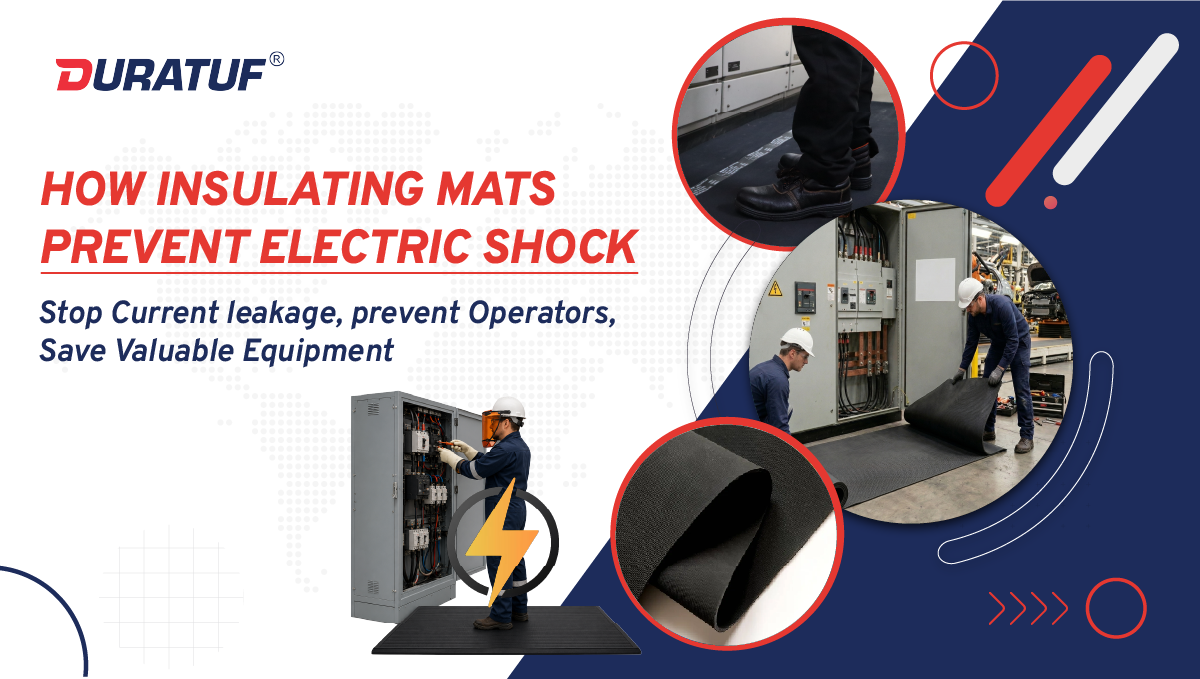
How Insulating Mats Prevent Electric Shock to Operators
Understand the exact mechanism behind IEC 61111, ASTM D178 and IS 15652 rated insulating mats, and what keeps that protection real over time.
Why does your panel room still carry an EHS audit flag for inadequate insulation coverage? Why does the same procurement request for insulating mats keep coming back with the wrong voltage class attached?
If either question sounds familiar, you are not alone. Plant managers, EHS officers, and procurement teams across manufacturing, utilities, process industries and other sectors ask simpler version of the same question every day: “does an insulating mat actually stop a person from getting shocked, and how?”.
The short answer is yes, but only within its tested class, and only if it is selected, tested, and maintained correctly. Here is exactly how insulating mats work, what protects you, and what does not.
Why Electric Shock Injuries Are Rising in Industry
Electrical safety failures are not decreasing. Non-fatal electrical injuries involving days away from work rose to 5,180 combined cases in 2023 and 2024, a 59% increase over the previous two-year period, according to Bureau of Labor Statistics data compiled by the Electrical Safety Foundation International. Lockout-tagout, the control most directly tied to electrical hazard exposure, remains one of OSHA’s ten most frequently cited standards year after year.
The pattern behind these numbers is consistent that is the control that should have prevented the injury existed on paper, but failed in practice, wrong class, degraded material, or a missed inspection. An insulating mat is one of the most direct and cost-effective controls available for the specific hazard of ground-fault shock at the work surface. Understanding exactly how it works is what turns it from a compliance checkbox into real protection.
Insulating Mats For Electric Shock Prevention: 4 Key Mechanisms
1. Insulating Mats Break the Path to Ground
Electric shock happens when current finds a path from a live conductor through a person’s body into the earth. Concrete, tile, and unprotected metal flooring conduct current well enough to complete that path. Rubber does not.
An insulating mat placed under switchboard, control panels, and MCC rooms interrupts this path. If an operator contacts a live component, the mat’s dielectric resistance stops current from completing the circuit to ground through their feet. This is the single mechanism behind every voltage-rated insulating mat on the market, whether it is IEC 61111, ASTM D178, or IS 15652 rated.
2. Voltage Class Ratings Absorb the Differential (IEC 61111, ASTM D178, IS 15652)
Every mat is rated to withstand a specific voltage before it breaks down and starts conducting. This rating has to exceed the system voltage of the equipment it protects, with margin. The table below shows how this works across the Class 0-4 system shared by IEC 61111 and ASTM D178:
| Class | Max Use Voltage | AC Proof Voltage | Withstand Voltage | Recom. Thickness |
| 0 | 1.0 kV | 5.0 kV | 10.0 kV | 2.0 mm |
| 1 | 7.5 kV | 10.0 kV | 20.0 kV | 2.0 mm |
| 2 | 17.0 kV | 20.0 kV | 30.0 kV | 3.0 mm |
| 3 | 26.5 kV | 30.0 kV | 40.0 kV | 4.0 mm |
| 4 | 36.0 kV | 40.0 kV | 50.0 kV | 5.0 mm |
A Class 2 mat under a 17kV panel is not just properly rated, it is rated to withstand nearly double that voltage before failure. That margin is what protects the operator if there is a transient spike above normal operating voltage.
In India IS 15652 standard uses a separate Class A, B, C system with its own working voltage and dielectric strength figures:
| Class | Thickness | Working Voltage | AC Proof Voltage | Dielectric Strength |
| A | 2.0 mm | 3.3 kV | 10.0 kV | 30.0 kV |
| B | 2.5 mm | 11.0 kV | 22.0 kV | 45.0 kV |
| C | 3.0 mm | 33.0 kV | 36.0 kV | 65.0 kV |
A mat purchased for an IEC 61111 application should never be substituted into an IS 15652 rated site without checking the class mapping first.
3. Leakage Current Limits Keep Shock Risk Below Harmful Levels
Even a compliant mat allows a very small amount of current to pass through under test conditions, this is leakage current. IS 15652 caps this at 10 mA maximum. Below this threshold, the current is too small to cause harmful shock even under fault conditions. This is why dielectric testing matters, a mat can look intact and still exceed safe leakage current once the material has degraded.
4. Chemical and Ageing Resistance Extend Insulating Mat Protection
A mat only protects reliably if it survives the environment it is installed in. IEC 61111 rated mats must retain at least 80% of their original puncture resistance after accelerated ageing at 70°C for 168 hours, and must show no visible cracks after exposure to -25°C. ASTM D178 mats are tested separately for oil, ozone, and flame resistance depending on Type. This is why the correct standard and grade matter as much as the voltage class. A mat that is voltage-rated correctly but chemically unsuited to its environment will degrade and fail its protective function long before its rated life is up.
How to Choose and Maintain Insulating Mats for Maximum Protection
- Match class to system voltage, not just proximity. Confirm the actual system voltage of the equipment before ordering. Rounding up to “whatever class is in stock” defeats the margin the class system is built to provide.
- Confirm the standard fits your market. IEC 61111 for international buyers, ASTM D178 for the Americas, IS 15652 for India. Mixing standards across markets creates compliance gaps at the buyer’s end, not just yours.
- Retest on a schedule, not just at installation. Dielectric properties degrade with age and use. A mat that passed its test three years ago is not guaranteed to pass today.
- Store and inspect like you would any safety equipment. Keep mats flat, dry and away from direct sunlight or ozone-generating equipment. Check for punctures, cracks or surface hardening before each use.
Insulating Mats Only Protect When Rated and Maintained Correctly
An insulating mat is not a passive floor covering, it is an active electrical control with a specific, testable mechanism for blocking the path to ground within a defined voltage margin. That mechanism only holds if the class matches the equipment, the standard matches the market, and the mat is retested on schedule. Given that electrical injury rates are climbing rather than falling, treating mat selection and maintenance as a checkbox is the gap most worth closing first.
Frequently Asked Questions
Insulating mats are placed under switchboard, panels, and control equipment to break the electrical path between a live component and the earthed floor. Rubber's dielectric properties block current flow to ground, so if a worker contacts a live part, the mat prevents current from completing a circuit through their body into the earth.
Electrical rubber mats reduce shock and electrocution risk at the point of contact, cover voltage classes from 1kV to 36kV depending on grade, resist oil, ozone and ageing per IEC 61111, ASTM D178 or IS 15652 testing, and function as a reusable safety layer rather than disposable PPE.
Rising plant electrification, stricter EHS audit requirements, and utility compliance mandates such as DEWA, ADDC and SEWA in the Gulf, and IS 15652 in India, have made insulating mats a basic requirement in substations, control rooms,switchboard areas and near such equipment carrying high-voltage electricity.